 Ubeswap
 liquidity pools and fee accrual in V2 and V3
Updated on
Ubeswap liquidity pools accrue trading fees differently in V2 reserves and V3 positions defined by a price range. V2 adds fees to the pool, increasing the assets backing liquidity provider tokens. V3 records fees separately and awards new fees only to liquidity active at the traded price. Choosing between them involves the fee collection method, the assets supplied and the attention a position needs. A swap fee percentage measures the charge on trading volume, not a return on the amount deposited. Farming rewards form another income stream when a matching incentive program is active.
An inactive V3 position retains previously earned fees while its deposited liquidity stops accruing new trading fees outside the range.
Pool Assets, Swaps and the Fee Base
Each pool holds a pair of Celo assets. Swappers exchange one asset for the other, changing the quantities held in the pool. A provider supplies the liquidity supporting those trades and receives a claim on the position's assets. Trading activity creates fee income, while the provider's eligible liquidity determines its share. Depositing assets alone does not create swap fees: the pool must process trades. Earnings change with trading volume, the fee allocated to providers and competing liquidity. Those variables explain why a fixed swap fee cannot establish a fixed annual yield.
V2 Pool Shares and Reserve-Based Fees
V2 liquidity providers hold fungible LP tokens representing proportional claims on one pool's reserves. Providers in the same pool share the same full-range pricing curve. Their fee shares follow their proportion of LP ownership, with any protocol fee dilution reflected in the total supply.
Balanced Contributions
An addition to an existing V2 pool matches its current reserve ratio, equivalent to equal value on both sides at that pool's price. The 50:50 requirement concerns value, not matching token counts. A token with a different price requires a different quantity. Initial pool creation is a separate case because the first deposit establishes the starting ratio.
Fees Retained in Reserves
A Ubeswap V2 pool charges 0.30% of the swap input it receives. The pool retains those fees in its reserves, increasing the assets backing LP tokens. Liquidity removal redeems a proportional share of the assets then held in the pool. The redemption therefore includes the position's accrued trading fees.
The factory's
feeTo
setting controls whether the V2 protocol fee is enabled. When enabled, the pair can mint LP shares for the configured recipient during liquidity additions or removals. The minting formula targets one-sixth of the increase in the square root of the reserve product. This corresponds approximately to a 0.05% protocol share and 0.25% LP share of swap input. Disabling the protocol fee leaves the 0.30% swap charge unchanged while removing this protocol allocation.
An LP token balance can remain unchanged while its underlying token amounts change through swaps and accumulated fees.
V3 Ranges and Position-Level Fee Balances
V3 liquidity attaches to a chosen price interval. Ubeswap's V3 position manager represents each position with a non-fungible token, or NFT. Its token pair, fee tier and range identify the underlying liquidity. Positions sharing a pool can have different ranges and different fee earnings.
Active Liquidity Inside the Range
Only liquidity active at the traded price participates in fee distribution for that part of a swap. A narrower range concentrates supplied capital around fewer prices. That can increase its share of active liquidity with the same capital, while restricting where the position earns. The relevant comparison uses active liquidity at those prices, not total deposits across every range. Any enabled V3 protocol fee reduces the swap fees available to providers; the pool's fee tier describes the total trading charge.
Balances Outside the Range
A position outside its range stops earning new trading fees. Its principal consists entirely of one pool asset once the price passes a range boundary. The position remains in place and can become active again if the price returns inside. Previously accrued fees remain attached to the position; becoming inactive does not erase that balance.
Collection Without Automatic Reinvestment
V3 keeps earned fees separate from the position's working liquidity. Collecting fees does not itself add liquidity or require removing the principal. Reinvestment requires a liquidity addition. A position can therefore retain the same liquidity amount while its uncollected fee balance grows.
Pool Parameters and Their Applicable Conditions
The V2 swap rate belongs to the pool contract, while V3 uses a pool fee tier alongside position-specific ranges. The contribution ratio below applies to additions to an existing V2 pool. V3 additions use both assets when the current price lies strictly between the chosen boundaries. Their required proportions depend on that range and price, without a fixed 50:50 value split. At or beyond either boundary, an addition uses only one asset.
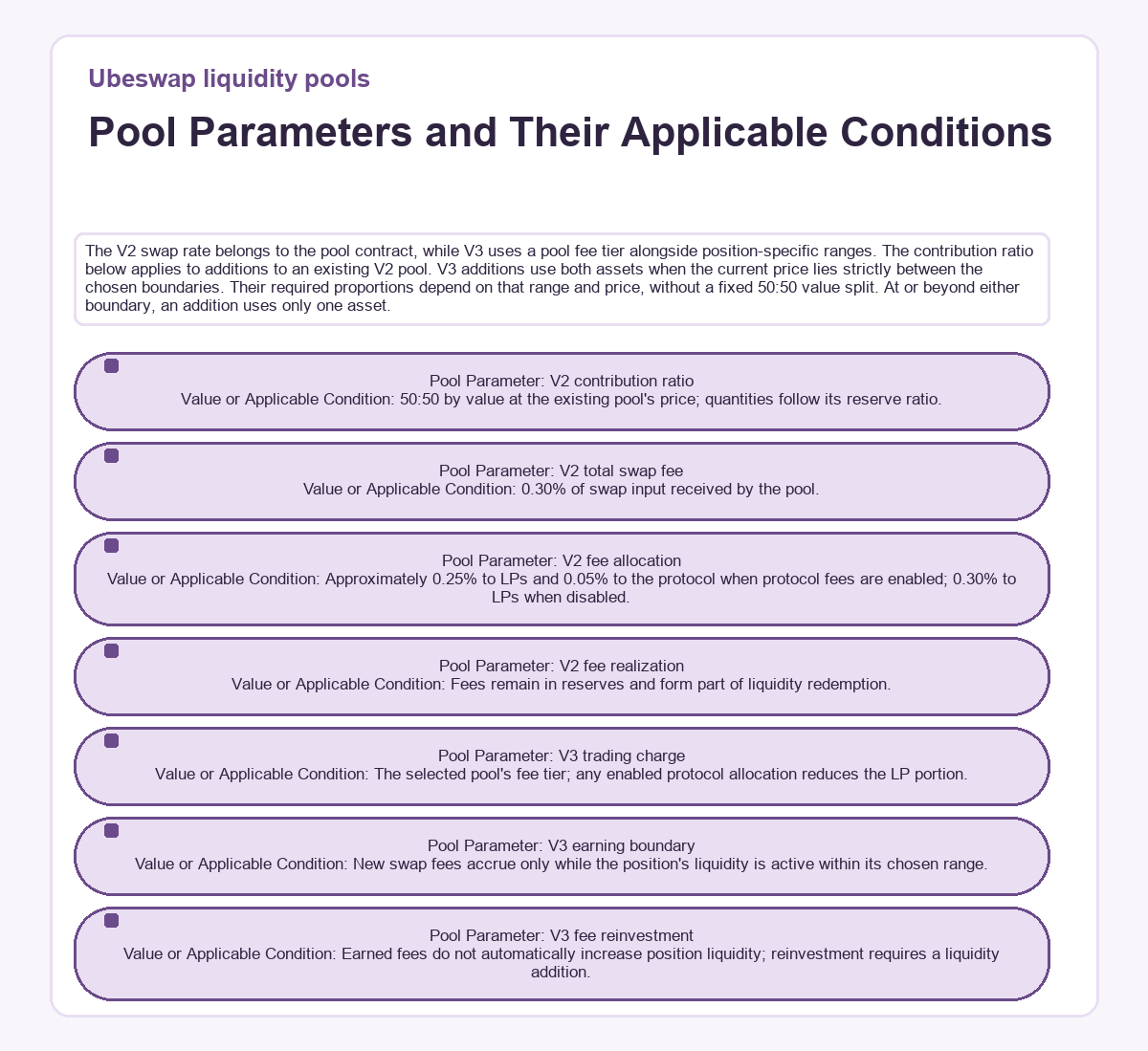
| Pool Parameter | Value or Applicable Condition |
|---|---|
| V2 contribution ratio | 50:50 by value at the existing pool's price; quantities follow its reserve ratio. |
| V2 total swap fee | 0.30% of swap input received by the pool. |
| V2 fee allocation | Approximately 0.25% to LPs and 0.05% to the protocol when protocol fees are enabled; 0.30% to LPs when disabled. |
| V2 fee realization | Fees remain in reserves and form part of liquidity redemption. |
| V3 trading charge | The selected pool's fee tier; any enabled protocol allocation reduces the LP portion. |
| V3 earning boundary | New swap fees accrue only while the position's liquidity is active within its chosen range. |
| V3 fee reinvestment | Earned fees do not automatically increase position liquidity; reinvestment requires a liquidity addition. |
Trading Depth and Competition for Fees
Greater liquidity depth generally reduces price impact for a trade of a given size. Providers supplying that depth share fees with other eligible liquidity. A busy pool with substantial deposits can still give an individual position a small share. Conversely, a large percentage share creates little fee income without trading volume. V3 adds another variable: liquidity can be dense around one price while sparse elsewhere. Total pool value therefore does not reveal the depth available throughout a position's range.
Farming Incentives Alongside Pool Fees
Farming rewards require an active incentive program and qualifying liquidity. In Ubeswap's LP-token farming model, depositing matching LP tokens leaves the underlying pool exposure in place. Trading fees continue accumulating in reserves while the farm accounts for its rewards separately. UBE farming emissions and trading fees have different origins and eligibility conditions. The existence of an LP token or V3 position alone does not establish a currently funded reward program.
Token Exposure and Management Costs
Fee income can rise while the value of a position falls. Swaps alter the token mix, and the assets can change in market value. Impermanent loss describes the shortfall against holding the original token quantities separately, before considering earned fees. That comparison differs from measuring a loss against the original deposit value. A growing fee balance therefore cannot establish the overall return. The remaining assets and the chosen comparison must also enter the calculation.
Celo network fees affect the proceeds from collecting, adding or removing liquidity. Changing a V3 range involves liquidity management and its transaction costs. V2 reserve-based accrual avoids a separate collection operation for trading fees, but withdrawing liquidity still uses a transaction. V3 permits fee collection while keeping the position open.
V2 and V3 Choices for the Same Liquidity Task
V2 keeps liquidity on the pool's full price curve and incorporates fees into reserve-backed LP tokens. A provider has no individual range to select. V3 concentrates capital within chosen boundaries, making the fee tier and active liquidity at each price relevant to earnings. A narrower position carries interruptions in fee earning when prices leave its range. Widening it changes capital concentration without establishing higher total income.
Where both versions offer the same token pair, compare their fee income over the same observation period using equal starting deposit values. Each position's fee allocation and share of eligible liquidity determine its fee income. Changing token balances and network costs also affect the value available on withdrawal. Different versions can attract different trading volume, so a higher fee tier alone does not identify the higher-earning position.
A V3 position keeps its chosen boundaries, so following a new price interval requires moving liquidity into a different range.
Still wondering about Ubeswap liquidity pools?
What Identifies a V3 Pool When Token Symbols Match?
A V3 pool is identified by its two token contract addresses and its fee tier within the selected factory. Symbols alone do not distinguish different token contracts. The same pair can also have pools at different enabled fee tiers. Trading volume and fee history belong to that specific pool, so another pool's figures do not describe the liquidity being evaluated.
When Does Approving Tokens for a Pool Start Fee Accrual?
A token approval grants spending permission and does not itself create a liquidity position. Earning trading fees requires liquidity actually supplied to the pool. V2 providers earn through their reserve-backed LP shares. A V3 position must also have liquidity active at the traded price. A completed approval alone therefore establishes neither a pool deposit nor an earning balance.
Where Are Farmed LP Tokens Reflected If the Wallet Balance Falls?
LP tokens deposited in a farm appear in the account's farm stake, while the wallet balance reflects tokens held directly. The underlying liquidity can remain in the pool throughout that deposit. A lower wallet LP balance alone does not show liquidity redemption. The farm stake identifies the deposited claim separately from the account's unstaked LP tokens.
Are Pool Trading Fees Always Paid in UBE?
Trading fees accrue in the pool's traded assets, while an eligible farming incentive can distribute UBE separately. V2 retains fee assets within the reserves backing LP tokens. V3 tracks amounts owed in the position's pool tokens. Those amounts depend on the trading activity and applicable fee allocation. A farming reward does not change the denomination of the pool's underlying trading fees.
Does Transferring V2 LP Tokens Move Their Claim on Pool Reserves?
Transferring V2 LP tokens transfers their proportional claim on the pool's reserves to the receiving account. The reserve claim includes the effect of previously retained fees, without a separate payout to the sender at transfer. Moving the LP tokens does not itself remove the underlying liquidity. Any LP tokens the sender retains continue representing their remaining pool share.